Things that go tweet in the night
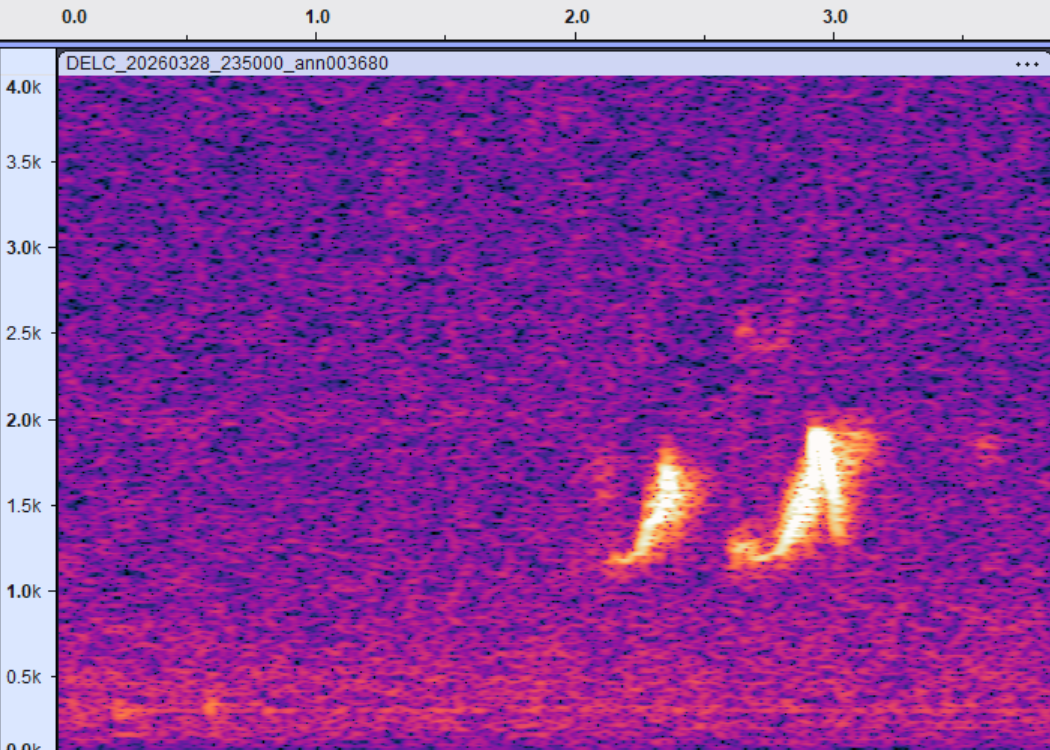
A Noisy Pitta gives its emphatic “walk-to-work” call as it flies on migration over suburban Carindale, Brisbane. Recorded at 2.23 AM on 26th March 2026.
Each year, millions of birds move across Australia under the cover of darkness.
We know this is happening. Weather radar has revealed large-scale, highly structured movements of animals across the continent, particularly along the east coast. These data show clear pulses of migration, with birds moving at consistent times of year and often on favourable winds. 70% of migrating birds are flying at night.
But there is a massive gap in our understanding of this phenomenon, which means migratory birds are risk. Radar can tell us that birds are moving — how many, how high, and when — but not which species are involved.
Bridging that gap is a grand challenge in Australian ecology.
To start to address it, we have launched a new project based on nocturnal passive acoustic monitoring:
https://dbl3raf.github.io/nfc-aus/index.html
The premise is straightforward. Many birds migrating at night produce vocalisations — either specialised nocturnal flight calls or just their daytime song or call — that can be recorded with a microphone from the ground. By capturing and identifying these calls, it becomes possible to link the large-scale movement patterns seen on radar with the species responsible for them.
In practice, this is not trivial.
Nocturnal recordings contain thousands of brief sounds, many of them faint, overlapping, or embedded in background noise. For most Australian species, flight calls are poorly documented, and in many cases not described at all. As a result, a large proportion of calls remain unidentified.
Our new Nocturnal Bird Calls of Australia website has been developed to help tackle this problem.
The site provides a structured, growing library of nocturnal calls, combining:
audio clips extracted from overnight recordings
corresponding spectrograms
classification into consistent call types
Rather than assuming a single call per species, the resource is organised around repeatable acoustic patterns. This allows users to recognise and group similar calls, even when species identity is uncertain. Over time, these call types can be linked to species through accumulation of evidence.
Importantly, the library also retains unknown and unresolved call types. These are not treated as noise (pun intended), but as data — recurring signals that represent real biological events, even if their source is not yet known.
This approach reflects the current state of knowledge. We are now able to record nocturnal migration at scale, but the process of assigning species identities is still catching up.
The project is explicitly designed as a collaborative effort. We already have thousands of annotated calls, but scaling up is essential if we are to resolve species identities and link them robustly to migration patterns.
How you can get involved
There are several ways to contribute:
Share recordings
If you have nocturnal audio recordings — from dedicated acoustic devices or other sources — we would be very interested in incorporating them into the project.
Help with annotation
If you have some spare time, you can help label recordings. This is a practical way to contribute to research while building familiarity with Australian bird sounds, particularly nocturnal calls.
Help identify unknown calls
Browse the library of unresolved call types. If you recognise a call and can suggest an identification, we would love to hear from you.Develop research projects
The database opens up a wide range of research opportunities, from species identification and call classification through to linking acoustic data with radar-derived migration patterns.
If any of these are of interest, please get in touch.
Linking acoustic data with radar observations offers a particularly powerful opportunity. Radar provides the big picture of migration intensity and timing, while acoustics provides the species-level detail. Together, they can reveal which species are moving, when they are moving, and how those patterns vary across space and time.
This new resource is an early step toward that goal.
For now, many of the calls remain unidentified. But that is part of the point. The project opens up a tractable pathway for resolving one of the key unknowns in Australian ornithology: who is moving over Australia at night — and when.