Urgent management for Moreton Bay shorebirds
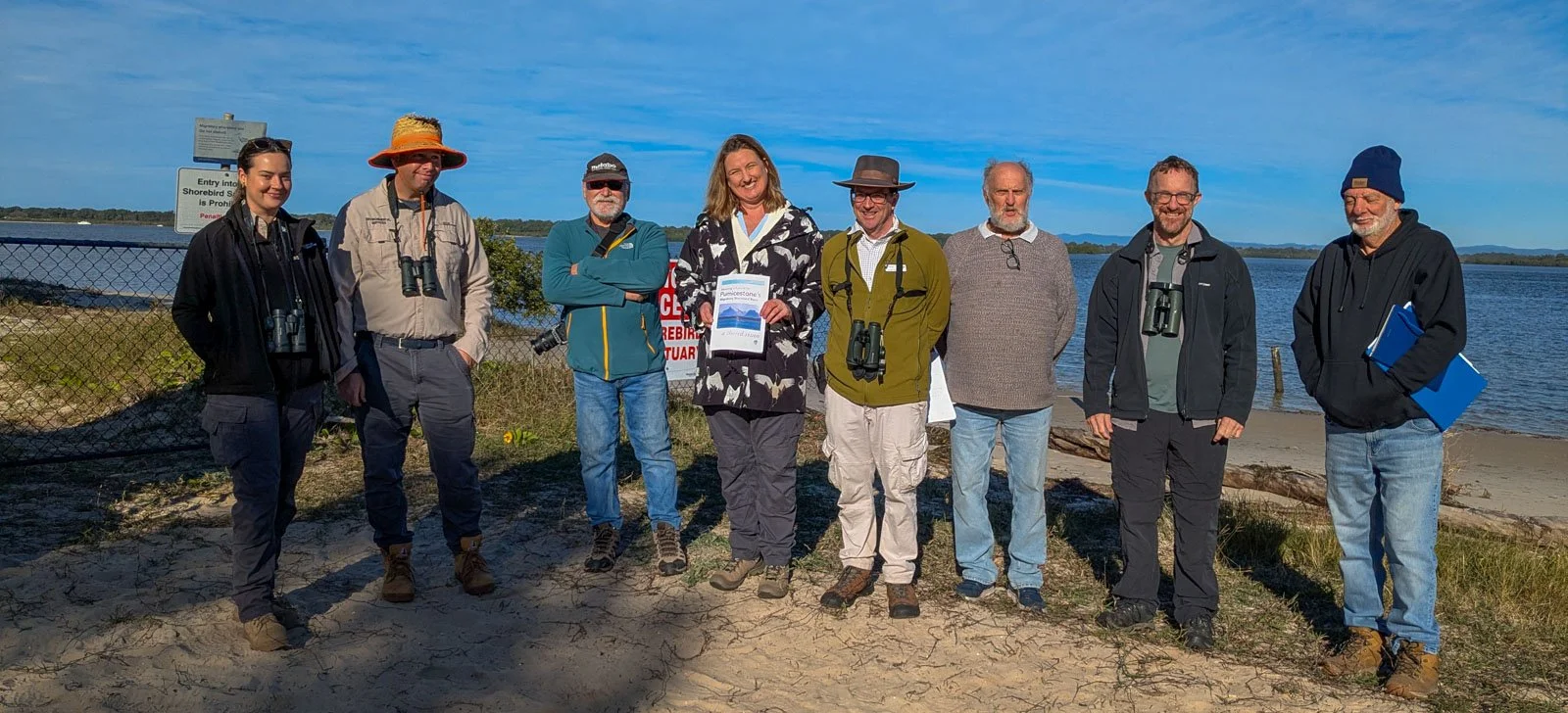
The audit team at Kakadu Shorebird Roost (from left to right, Taylor Cooper, Andrew Evans, Borys Daniljchenko, Aimee Freimanis, Gary Kane, David Edwards, Richard Fuller, Michael Strong).
Today, Richard Fuller joined colleagues from the Queensland Wader Study Group (QWSG), Bribie Island Environmental Protection Association (BIEPA), and City of Moreton Bay Council stakeholders for a fresh audit of the Kakadu Beach migratory shorebird roost site on Bribie Island.
The findings were deeply concerning.
Kakadu Beach is one of the most important migratory shorebird roost sites in Moreton Bay. Every year, threatened migratory shorebirds returning from the East Asian–Australasian Flyway depend on this site as a safe place to rest and roost at high tide. Species using the site include Bar-tailed Godwits, Far Eastern Curlews, Great Knots and many others that undertake extraordinary migrations between Australia and the northern hemisphere.
Unfortunately, the condition of the roost has deteriorated severely.
The most urgent problem is the dramatic loss of sand from the foreshore. Large areas of the gently sloping roost area have eroded away, leaving a steep drop between the dune and the sea. Shorebirds require broad, open, gently sloping sandy areas where they can safely rest while maintaining visibility of approaching predators and disturbance. Right now, very little suitable roosting space remains.
This is now an emergency management issue.
Without urgent sand augmentation and re-profiling works, there is a serious risk that the site will no longer function effectively as a shorebird roost. With migratory shorebirds due to begin arriving back in Australia in late spring, it is critically important that restoration works are completed this winter.
The audit also identified a number of additional management issues, including overgrown dune vegetation, the need for better screening and fencing in some areas, and opportunities to improve public infrastructure and reduce disturbance to birds. Many of these issues mirror those identified in a previous audit, reinforcing the need for a coordinated and ongoing maintenance program. It is wonderful to see Moreton Bay City Council taking a lead on pushing this work up the agenda.
Importantly, this is not simply about birds. Kakadu Beach is a remarkable community asset. It provides opportunities for local residents and visitors to connect with wildlife, supports nature-based tourism and birdwatching, and contributes to the ecological health and identity of Moreton Bay.
The positive news is that the solutions are straightforward and achievable. Previous management interventions at Kakadu Beach have shown that the roost can function extremely well when properly maintained. Sand re-profiling, vegetation management and ongoing maintenance can restore the site and ensure it remains viable for migratory shorebirds into the future.
We greatly appreciate the long-term efforts that have already gone into maintaining the site and acknowledge the many competing pressures faced by local government. However, the current condition of the roost means that action is now urgently required.
The Fuller Lab looks forward to continuing to work collaboratively with QWSG, BIEPA, local community members and Council to help secure the future of this nationally important shorebird site.